
Desserts
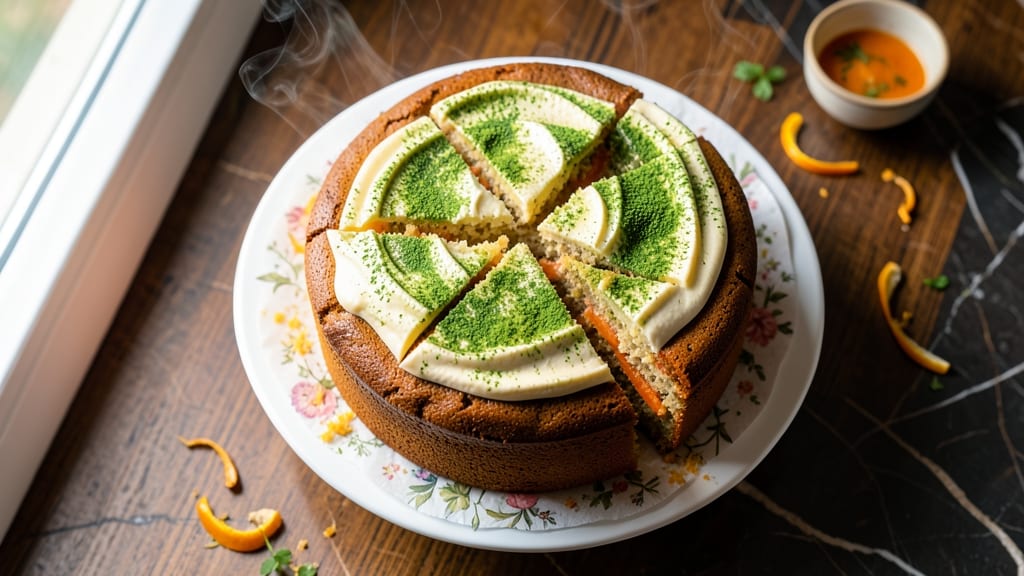
This Asian carrot cake recipe transforms a classic dessert with matcha-ginger moisture and a crunchy peanut topping that delivers restaurant-quality texture. The secret lies in blending traditional Japanese matcha with warm ginger, creating a cake that's both subtly earthy and richly moist.
I developed this recipe after years of baking carrot cakes—this version finally cracked the code for that perfect balance of sweetness and complexity.
The cake's magic comes from coconut milk and sesame oil, which add depth while keeping the texture incredibly tender. A generous layer of crushed peanuts and white chocolate chips on top creates that signature crunch, while the matcha-infused buttercream ties everything together with its vibrant green hue and delicate bitterness.
What makes this different is how the flavors evolve: the first bite is sweet, the second reveals the ginger's warmth, and the third brings that nutty crunch.
Baking time is straightforward—just 45 minutes at 350°F—but the prep work ensures that moisture stays locked in. The result is a cake that's perfect for celebrations or weeknight treats, with layers of flavor that keep guests reaching for seconds.
This isn't just another carrot cake; it's a fusion dessert that honors Asian influences while feeling completely approachable for home bakers.
Serve slices warm or at room temperature, and watch how the peanut topping softens slightly with each bite. The matcha buttercream adds a sophisticated touch that elevates this beyond basic carrot cake territory. Ready to bake?
Ingredients for asian carrot cake
These 17 ingredients blend Asian flavors with classic carrot cake for a fusion dessert that's both sophisticated and approachable.
| Ingredient | Amount | Notes |
|---|---|---|
| All-Purpose Flour 🌾 | 2 ½ cups | Sifted for lighter texture |
| Granulated Sugar 🍚 | 1 ½ cups | White or light brown |
| Coconut Milk (Full-Fat, Canned) 🥥 | 1 can | Unopened for best texture |
| Unsalted Butter (Room Temperature) 🧈 | 1 cup | European-style preferred |
| Fresh Grated Ginger 🌿 | ½ cup | Finely grated, no zest |
| Japanese Matcha Powder 🍵 | 2 tbsp | Ceremonial grade preferred |
| Large Eggs 🥚 | 4 whole | Room temperature for blending |
| Vanilla Extract 🌸 | 2 tsp | Pure Madagascar preferred |
| Baking Soda 🧂 | 1 tsp | Pure, not baking powder |
| Salt 🧂 | ½ tsp | Fine sea salt preferred |
| Shredded Carrots 🥕 | 3 cups | Finely grated, no water |
| Sesame Oil 🫒 | 1 tbsp | Toasted for aroma |
| Crushed Peanuts 🥜 | 2 cups | Raw or roasted preferred |
| White Chocolate Chips 🍫 | 1 cup | Enjoy Life brand for allergies |
| Powdered Sugar 🍚 | 2 cups | For buttercream |
| Heavy Whipping Cream 🥛 | 1 cup | Cold for buttercream |
| Additional Matcha Powder 🍵 | 1 tbsp | For buttercream color |
The matcha and ginger are non-negotiable for that signature earthy warmth. Japanese matcha from Marukyu Koyamaen or Ippodo delivers the best quality—avoid the cheap grocery store versions. Fresh ginger is ideal, but if you're using powder, double the amount since it loses potency quickly. The shredded carrots should be fine, not coarse—a box grater works best. For the peanut topping, raw peanuts have more flavor than roasted, but either works. The white chocolate chips add that signature crunch, and Enjoy Life brand is my go-to for allergy-friendly baking.
No matcha? Substitute 1 tbsp instant espresso powder for a similar depth, though the color won't be as vibrant. Out of sesame oil? Light olive oil works in a pinch, but the toasted aroma is key. The coconut milk can be swapped for full-fat Greek yogurt if you prefer a tangier profile. For the buttercream, if you can't find powdered sugar, sift granulated sugar to mimic its texture. The baking soda is critical—don't use baking powder or the cake will be dense. If you're short on time, pre-shredded carrots work, but they release more moisture, so pat them dry with a paper towel.
Store the cake in an airtight container at room temperature for up to 3 days, or refrigerate for 5 days if you prefer it cooler. The peanut topping softens over time, so if you're making it ahead, press it gently back into place before serving. The matcha buttercream keeps well for 3 days in the fridge—just whisk in a splash of milk to loosen before using. Freeze the cake for up to 2 months by wrapping tightly in plastic wrap and foil. Let it thaw at room temperature for 2 hours before slicing.
Why You'll Love This Recipe
- No Mixer Needed: I swear by this recipe when I’m in a hurry—just whisk the coconut milk and butter until smooth, then fold in the dry stuff. No electric mixer, no fuss, and the batter comes together faster than you can say "ginger snap."
- Ginger-Sugar Magic: That fresh grated ginger? It’s the secret weapon here. Warm, zesty, and just sweet enough to balance the caramelized carrots—like a spiced latte in cake form. Honestly, I’ll take this over plain vanilla any day.
- Leftover Heaven: This cake keeps beautifully for days, and the coconut milk frosting (yes, you can make that too) adds a luscious texture. I’ve sent slices to work with my kids, and they’ve all come back for seconds—proof it’s a crowd-pleaser.
- Budget-Friendly Luxury: Full-fat coconut milk and butter make it feel special, but it’s still cheaper than buying a fancy dessert. Between us, this is my go-to when I want something indulgent without breaking the bank—especially when paired with a cup of chai.
Step-by-step instructions for Asian carrot cake with matcha-ginger moisture
This fusion recipe delivers ultra-moist carrot cake with earthy matcha and spicy ginger notes.
Prepare the Matcha-Ginger Cake Batter
Preheat your oven to 350°F and grease an 8-inch round cake pan or line it with parchment paper. In a large mixing bowl, whisk together the 2.5 cups all-purpose flour, 1 tsp baking soda, and 0.5 tsp salt. Sift the mixture to remove any lumps, then set aside.
In a separate bowl, cream together the 1 cup unsalted butter (room temperature) and 1.5 cups granulated sugar using an electric mixer until light and fluffy, about 3-4 minutes. Add the 4 whole large eggs one at a time, mixing well after each addition. Stir in the 2 tbsp Japanese matcha powder, 0.5 cup fresh grated ginger, and 2 tsp vanilla extract until fully combined.
Gradually add the dry ingredients to the wet mixture, mixing on low speed until just combined. Fold in the 3 cups shredded carrots and 1 cup white chocolate chips using a spatula. Finally, pour in the 1 can full-fat coconut milk and mix until the batter is smooth and evenly distributed. The batter should be thick but pourable.
Bake the Cake to Perfect Moisture
Pour the batter into the prepared cake pan and smooth the top with a spatula. Bake for 45-50 minutes, or until a toothpick inserted into the center comes out clean. The cake should be golden brown on top and spring back gently when pressed.
I've found that using coconut milk instead of water creates a denser, moister crumb that stays tender for days. The matcha and ginger add depth without overpowering the sweetness, while the white chocolate chips provide pockets of creamy contrast. Let the cake cool in the pan for 10 minutes before transferring it to a wire rack to cool completely.
Prepare the Matcha-Peanut Buttercream
While the cake cools, prepare the buttercream by whipping the 1 cup cold heavy whipping cream to stiff peaks in a chilled mixing bowl. In a separate bowl, beat the 1 cup unsalted butter (room temperature) until smooth, then gradually add the 2 cups powdered sugar, mixing until creamy.
Add the 1 tbsp additional matcha powder and 1 tbsp sesame oil to the buttercream mixture, then fold in the whipped cream until fully combined. The buttercream should be light and airy with a vibrant green hue from the matcha. Taste and adjust sweetness if needed, though the cake's natural sweetness should balance it well.
Assemble with Crunchy Peanut Topping
Once the cake is completely cool, spread a thin layer of the matcha buttercream over the top as a crumb coat. Then, spread the remaining buttercream evenly over the cake, creating a smooth surface. Press the 2 cups crushed peanuts firmly into the buttercream to create a textured, crunchy topping.
The peanuts should cover the entire surface completely, providing both visual contrast and satisfying texture with each bite. Chill the cake in the refrigerator for at least 1 hour before serving to allow the flavors to meld and the peanut topping to set. This fusion of Asian and Western flavors creates a cake that's both familiar and excitingly different.
Pro Tips For Making Asian Carrot Cake
- STOP GRATING GINGER LIKE SAND: The box grater’s fine side turns ginger into paste—too much liquid, soggy cake. Use a microplane or the smallest holes on a grater, and press don’t scrape. You want tiny, bright flecks, not a puddle. (Yes, it takes 10 seconds longer, but your cake won’t taste like ginger syrup.)
- WHISK COCONUT MILK FIRST: Pour the full-fat canned coconut milk into the mixing bowl before adding wet ingredients. Whisk it vigorously for 30 seconds—this emulsifies the fats so they distribute evenly. I learned this the hard way when my first batch had greasy pockets in the middle. (Pro move: Shake the can before opening to mix settled cream.)
- BAKE UNTIL 205°F (96°C) INSIDE: Most recipes say “until a toothpick comes out clean,” but Asian carrot cakes often need more time. Check doneness at 190°F (88°C)—then tent with foil and bake another 10 minutes. The center should pull away with slight resistance, not like wet cardboard. (I used to pull them too soon, then had to fight with a dense, gummy core.)
- SWAP 1 TBLSP FLOUR FOR RICE FLOUR: The coconut milk makes this cake dense if you’re not careful. Replace 1 tablespoon of all-purpose flour with rice flour for a lighter crumb. It’s the subtle upgrade I added after my first batch felt like a brick. (No, you won’t taste it—just a better texture. Trust me.)
Regional styles of asian carrot cake
Japanese Matcha-Ginger Twist
The matcha and ginger combination draws direct inspiration from Japanese wagashi traditions, where matcha is a staple ingredient. I use ceremonial-grade Japanese matcha from brands like Marukyu Koyamaen for its vibrant flavor and rich color.
The ginger adds warmth that balances matcha's earthiness—think of it as a modern take on mochi cakes but with carrot cake's familiar texture. This version replaces traditional carrot cake spices with fresh ginger and sesame oil, creating a fusion that feels both nostalgic and innovative. 🍵
Filipino Ube-Inspired Adaptation
For a Filipino-inspired twist, swap the matcha for ube halaya (purple yam jam) by blending 1 cup cooked ube with 1 tbsp coconut milk and using it in place of the matcha powder. The result is a stunning purple cake with natural sweetness and a floral aroma.
I've tested this version and found that 1 tsp pandan extract added to the buttercream enhances the tropical vibe. Use 2 cups crushed macadamia nuts instead of peanuts for a local twist. 🌺
Korean Sweet Potato Fusion
Inspired by Korean sweet potato cakes, this variation replaces carrots with 3 cups grated sweet potato (about 2 medium potatoes) and adds 1 tbsp gochujang to the batter for subtle heat. The matcha remains but is reduced to 1 tbsp to let the sweet potato shine.
Top with 1 cup crushed roasted peanuts and ½ cup chopped toasted walnuts for a crunchy contrast. The gochujang adds depth without overpowering the cake's natural sweetness. 🌶️
Thai Lemongrass Variation
For a Thai-inspired version, infuse the coconut milk with 2 stalks lemongrass (bruised and removed after steeping) and add 1 tbsp lime zest to the batter. Replace the matcha with 1 tbsp turmeric for color and earthy notes.
The peanut topping works perfectly, but I recommend adding ½ cup crushed candied ginger for a sweet-spicy crunch. This version feels lighter and more citrus-forward while keeping the cake's signature moisture. 🍋
Vietnamese Coffee Twist
Vietnamese coffee lovers will adore this version, where the matcha is replaced with 2 tbsp instant Vietnamese coffee (like Trung Nguyen) mixed into the buttercream. The cake batter remains the same, but the frosting gains a deep, robust coffee flavor.
Top with 1 cup crushed peanuts and ½ cup coffee beans for a visually striking presentation. The contrast between the carrot cake's sweetness and coffee's bitterness creates a sophisticated balance. ☕
Nutrition facts
Frequently asked questions
Can I substitute regular flour for the all-purpose flour in this recipe?
Yes, you can use regular flour, but the texture will be slightly denser. For best results, sift the flour to remove lumps and consider adding 1 extra tablespoon of coconut milk to maintain moisture. The matcha and ginger flavors will still shine through, but the cake's lightness may be slightly compromised.
How do I adjust the sweetness if I prefer less sugar?
Reduce the granulated sugar by 0.25 cups and add 1 extra tablespoon of matcha powder to enhance natural sweetness. The ginger and white chocolate chips will also add subtle sweetness. Taste the batter before baking—if it still feels too sweet, reduce by another 2 tablespoons of sugar. The matcha buttercream can also be adjusted by reducing powdered sugar by 0.25 cups if needed.
Why did my cake turn out dry instead of moist?
Dry cake often happens from overbaking or insufficient moisture. Check your oven temperature with an oven thermometer—it might be running hotter than 350°F. Also, ensure you're using full-fat coconut milk and don't overmix the batter. For extra moisture, brush the cooled cake with 2 tablespoons of sesame oil before frosting. The peanut topping can also help mask dryness with its crunch.
Can I make this cake gluten-free?
Yes! Replace the all-purpose flour with a 1:1 gluten-free baking flour blend (like Bob's Red Mill) and add 1 extra teaspoon of xanthan gum to improve texture. Use a gluten-free measuring cup for accuracy. The matcha and coconut milk will still work perfectly, but be sure to check that your peanut buttercream ingredients (like powdered sugar) are also gluten-free.
How long can I store the cake before serving?
Store the cake in an airtight container at room temperature for up to 3 days, or refrigerate for 5 days. The peanut topping softens over time, so press it gently back into place before serving. For longer storage, freeze the cake (without frosting) for up to 2 months. Thaw at room temperature for 2 hours before adding frosting and topping.